 |
Authentic Classical Music |

|
|
Authentic Classical Music |
|
|
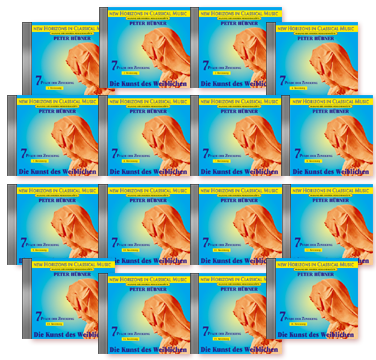
16 Meditations
Strings & Woodwinds
Peter Hübner
The Art of the Feminine
7 Paths of Love
label: Peace of Mind
total playing time: 12h 29’51”



“The soul of man is not an organ but animates and exercises all the organs; it is not a function like the power of memory, of calculation, of comparison, but uses these as hands and feet; it is not a faculty, but a light; is not the intellect or the will; is the vast background of our being in which they lie – an immensity that is not possessed and cannot be possessed.”
Ralph Waldo Emerson
Philosopher ____________ __
He who consciously appropriates this inner force is inspired but technically he must be adequately equipped to present the inspired ideas on paper convincingly.”
Max Bruch
„It is through
the Temple of Music we approach Divinity. It is here we Experience our true Resurrection.“ Goethe „Anyone who seriously researches Nature must have experienced a sense of religious Consciousness.“ Albert Einstein
|
THE COMPOSER ON
THE ART OF THE FEMININE |
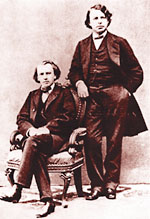 Johannes Brahms (sitting) and Joseph Joachim Johannes Brahms in discussion with the famous violinist and friend Joseph Joachim
“All this is most fascinating, Johannes, and I understand now why you have always
been so aloof in this respect, even with me. We are now treading on holy
ground. But if you feel that Bach, Mozart and Beethoven were more inspired
than you were, what do you think of me? My compositions, even my Hungarian Concerto, are being more and more neglected and will soon be forgotten, while yours are gaining in recognition from year to year.” “That is true, Joseph, but it will be another half century before I shall find my true place in the musical scheme. It is difficult, if not impossible, to explain why one composer is more inspired than another, but I can put my finger on one weak spot in your past, Joseph – too many official positions and posts of honour. You are the director of the Berlin Royal High School, you are in great demand as a violin soloist and as a quartet player, you devote a great deal of your time to teaching; the many conferences connected with your posts of honour encroach upon your time; you are flooded with manuscripts of composers for violin who seek your advice – to mention only a few of the troublesome and annoying inconveniences which have come within the scope of my own observations. All these things interfer with composing. A composer who wishes to write worth-while music must devote his whole time and energy to that one occupation. If I had had as many calls upon me as you have had, Joseph, I could not have created anything worth listening to, either.” “Granted, Johannes, but when we first met as young men, I was not burdened with all of those opressing loads; I had the creative urge, too, and yet the difference between your productions and mine were like day and night. No, there is a deeper reason. No doubt it is natural aptitude. It must have been very easy for Jesus of Nazareth to contact Omnipo-tence, just as it was for Beethoven; his ideas must have come with no conscious effort on his part, as witness the hundreds of wonderful themes in which his works abound.” “True, Joseph, but his sketch books prove that he too toiled incessantly in order to leave to posterity such masterpieces as the Eroica, the fifth, seventh and ninth symphonies, the fourth and fifth piano concertos and the violin concerto. That is why I have always taken him as my ideal; he had not only the highest inspiration but also supreme craftsmanship.”
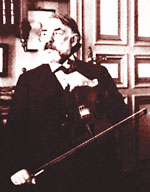 The famous Violinist Joseph Joachim
Joseph Joachim about
“To one
who knows him as well as I do, that is easily explained. Those secrets would have been invaluable to me as a young man. I also, through my early associations with Mendelssohn and Schumann, before I met Brahms, had ambitions to be a great composer; and if I had known then what I learned that last evening with him, I might have accomplished a great deal more than I did. Yes, I am convinced that he knows that young composers of the future will profit by his revelations concerning those higher spiritual laws. He himself gained very valuable information from the teachings of Jesus and of the great poets.”
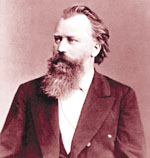 Johannes Brahms
It is the power that created our earth and the whole universe, including you and me, and that great Godintoxicated Nazarene taught us that we can appro priate it for our own upbuilding right here and now and also earn Eternal Life. According to Jesus’ own words, He was in that case not the great exception, but the great example for us to emulate. We are all sons of God, for we could not have come from any other source. The vast difference, however, between Him and us ordinary mortals is that He had appropriated more of divinity than the rest of us.
Of course,
to the disciples it appeared that Jesus was walking on the water, but in
reality He was walking in the air. His spiritual power was so great that
He could, by drawing on Omnipotence, rise superior to the Law of Gravitation.
We call that a supernatural power but supernormal would be a better term.
Brahms
“How different life on this earth would be if we could all consciously appropriate Omnipo-tence as Jesus did.”
Joseph Joachim
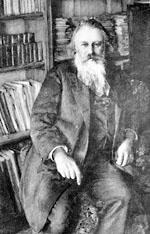 Johannes Brahms
By burying with their dead weapons, articles of clothing, and various utensils which they had in daily use, they beleived that the dead would need them in the next world. Ancient sepulchers and the many different modes of disposal of the dead, reveal to us the hope which long since vanished civilizations held of a future life. One of the most wonderful illustrations of the universality of the belief in another life is to be found in your American Indians, who were wholly segregated from all the rest of mankind, and yet they talked of the Great Spirit and the Happy Hunting Grounds where they would hunt after leaving this world. Their idea of heaven was a primitive one, to be sure, but one finds that the conceptions of that abode were always coloured by the state of civilization of the nations that believed in hereafter. However, all that is unimportant; what counts is the universality of that belief in a future life.
In the Holy
Writ it says in John 14, 10: ‘The father that dwelleth in me, he doeth
the works’.
Brahms
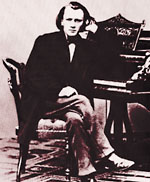 Johannes Brahms
The themes that will endure in my compositions all come to me in this way. It has always been such a wonderful ex-perience, that I never before could induce myself to talk about it – even to you, Joseph.
I felt that
I was, for the moment, in tune with the Infinite, and there is no thrill
like it. I can understand why the great Nazarene attached so little importance
to his life. He must have been in much closer rapport with the infinite
force of the Universe, than any poet or composer ever was, and He no doubt
had glimpses of that next plane, He called ‘heaven’.
Brahms
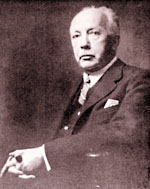
Richard Strauss
“..
but no matter how clever the workmanship, no composition will live unless
it is inspired.
When the inspiration comes, it is something of so subtle, tenuous, will-o-the-wisp-like
nature that it almost defies definition. When in my most inspired moods, I have definite compelling visions, involving a higher selfhood. I feel at such moments that I am tapping the source of infinite and eternal energy from which you and I and all things proceed. Religion calls it God.”
“It is of the utmost importance to put the thoughts on paper immediately lest
they quickly fade away. Once fixed I often look at them again and this conjures
up the same frame of mind that gave birth to them; thus the ideas grow and
expand. I am a firm believer in the germination of the idea.
I realize that the ability to have such ideas register in my consciousness
is a Divine gift.
I was, however,
definitely conscious of being aided by a more than earthly Power, and that
it was responsive to my determined suggestions.
Richard Strauss
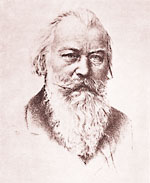 Johannes Brahms
Straightway the ideas flow in upon me, directly from God, and not only do I see distinct
themes in my mind’s eye, but they are clothed in the right forms, harmonies
and orchestration.
Brahms
|
|||||||||||
CLASSIC-Life:
Herr Hübner, you have created quite a number of pieces of work, which have
the title “The Art of the Feminine”. 16 of these have the subtitle
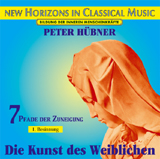
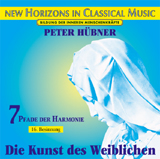
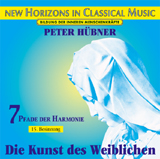
“Love”, and 16 further ones the title “Harmony”. When you listen to them, you notice that they are all related to each other. Can you tell us something about this? PETER HÜBNER: Yes, “Femininity” first of all is a delicate topic – during a time in which, especially in high positions, more and more women effectively stand up for themselves. Like the whole of nature, the microcosm of music presents us creative powers, conserving powers, and destructive powers. In the advanced civilisations of mankind the principles of “preservation” were attributed to the feminine element, and “creating” and “destroying” to the masculine. I have transferred the principles of conservation from the microcosm of music to the compositional, and used it in a fugue of up to five parts. The fugue theme can be frequently modified, without encroaching on the musical element of femininity in any way. In this respect, the 16 pieces of work are modifications of the very same feminine themes. Therefore, they differ from each other. It would require too much explaining to go into this in more detail – you can hear it all anyway. But there is also a special story behind this: all 16 pieces of work in a series are related to each other. One would think that it would be easy to memorise them, and musicians might assume that they would be able to play them from memory after a short time. But that is made especially difficult because of the close relationship of these pieces – if not even rendered impossible I therefore believe that a conductor, for instance, when he knows them all, couldn’t conduct these pieces from memory – whilst he could easily do so if he only knew one of them. CLASSIC-Life: Among the “Art of the Feminine” there are the two cycles “Love” and “Harmony”. In what way do they differ? PETER HÜBNER: Regarding the 5 polyphone voices, the particular individual movements are the same. But the series “Harmony” also has the basso continuo, which reveals the natural harmonious development – whereby this basso continuo is missing in the “Love” series. Why these two groups “Love” and “Harmony”? Here, I must explain in more detail. Imagine five children who are playing with each other in a meadow. The ideal natural harmonious contact of these five children is shown in the series “Love”, the children being symbolised by five voices. But the basis of a natural harmonious musical development can only be the basso continuo – which is indeed not played here, but to which the voices are directed. In the series “Harmony” this basso continuo is played, and it embodies the mother. Whilst in the series “Love” we experience the children’s play only with the mother’s omnipresence, in the series “Harmony” we experience the mother who is creating harmony in the basso continuo, and then only recognise unambiguously in her the basis for the natural harmonious development of the children’s play – the 5 voices. The interesting thing in “Love” is that in your subconscious – and the music expert perhaps also consciously – with the help of the children’s play: the 5 voices – you add the natural harmonious role of the mother in the basso continuo, sometimes though making a mistake. But you only notice this, when you later hear the corresponding piece of work with the corresponding number from the series “Harmony” with the basso continuo, i.e. with the role of the mother. In natural harmonious music, the basso continuo always determines the natural harmonious development, and so the basso continuo determines here also the natural harmonious development of the 5 voices – just as the mother determines the natural harmonious development of her five children. As this is about “The Art of the Feminine”, besides the mother, the five voices represent five girls. In “The Art of the Masculine” the father will correspondingly play the decisive harmonising part as the basso continuo, and the children playing are sons. But the matter is even more specific: In the first 4 “Meditations” there are not five different girls, but a girl playing by herself simultaneously in 5 parts. Musically it is about a theme that is set up to fivefold in playing musical motion within itselfintellectually guided and maintained by the mother as a basso continuo in the series “Love”, and physically and/or tonally in the series “Harmony”. Thus, in “Love” the mother is only present in the mind, and only determines the natural, harmonious fivefold dance of the girl through her mental presence, and in “Harmony” the mother is physically and/or tonally present, and in the basso continuo we experience the natural basis of the harmony of the fivefold dance. So far the “Meditations” 1-4 in “Love” and/or “Harmony”. In the “Meditations” 5-8 we are concerned with the fivefold dance of two girls. In the meditations 9-12 there is the fivefold dance of three girls, and in 13-16 the fivefold dance of four girls. The mother of all four girls is one and the same – which you can gather from the development of the basso continuo. And which of the girls is just dancing and in how many parts at the same time, can be gathered from the themes you are hearing. In an extended form, the “Metamorphoses” have developed from these two cycles “Love” and “Harmony” – whereby the or chestra was enlarged, as further motifs were added: new people of the musical action and/or dance – girls and boys. Now somebody might ask: Why is he doing all this? Here, he is producing a number of musical pieces with 5 voices in “Love”. Then, he adds the basso continuo in a further series “Harmony”. And finally in “Metamorphoses”, he brings in more musical themes and motifs. In “Metamorphoses” I have included everything. So why would I want ”Harmony” and “Love” as well? Here we might have the view of the music producer thinking of the economic aspect and/or the music consumer, who thinks in terms of the laws of economicalness. The matter has a different background. Every person must learn to deal with himself harmoniously. Almost everybody is aware of the fact that this is not easy and by no means always easy. In “Love” you, as the listener, can learn or get used to handling yourself simultaneously in an up to fivefold way – harmoniously! So you can learn to play 5 different parts simultaneously within yourself, without facing dissonant and/or disharmonious collisions, but on the contrary in a sensible togetherness – which is audibly proven by the music of 5 voices as a whole. Where do you nowadays find such a teaching and learning process? At home, in a nursery school, at school, at university, in your job? Such natural harmonious dealings with yourself is the pre-condition for natural harmonious dealings with other people. In the “Meditations” 5-8 – as I have already explained – we are concerned with the fivefold natural harmonious dealings of two sisters with themselves, and up to 5 x 5 = 25 fold with each other. Thus, the learning process is on the one hand the repetition of the fivefold dealings with yourself, as learned in the “Meditations” 1-4. But in addition, we now have the natural harmonious dealings with the sister, who at the same time handles herself in a fivefold way. Correspondingly, the educational scale is extended to No. 16. In the series “Harmony”, the knowledge is included that the same natural and inevitable laws of harmony determine all our inner lives: two or several people deal with themselves as well as each other according to the same harmonious laws. The “Metamorphoses” extend this individual and social educational process, and in addition, lift it into the ecological area. With the joining orchestra voices, the individual, the social community and thereby related and non-related people, and finally also the ecological conditions are integrated into the harmonious play, according to the same laws of harmony. Out of this “whole” nobody would be able to hear with certainty the harmonious togetherness of two or several people as well as the laws according to which this togetherness develops in the “Metamorphoses”, if there wasn’t also “The Art of the Feminine” the two groups “Love” and “Harmony” in the cycle. For the listener is too much distracted by the additional voices of the orchestra in the “Metamorphoses”, to clearly hear the fivefold conversation of an individual girl with herself, or the part of the mother. For this reason, it was and is necessary to record all three orders in a separate form. That is classical music: Education for the soul, as Socrates calls it. CLASSIC-Life: Herr Hübner, at your request, the picture of Maria was put on the CDs of “Art of the Feminine”. Do you regard her as a special personification of femininity? PETER HÜBNER: When I first saw this portrait of the Pieta in St Peter’s Cathedral in Rome – that was in 1972, I spent about half a year near Rome, and travelled quite regularly into town – I was deeply impressed by this work of Michelangelo. You have to imagine: a mother has just seen her son murdered – the worst that could ever happen to her. We are used to women turning hysterical, when they lose their handbags or their husbands stray. The average citizen all over the world would expect a women who has just lost her son, to be absolutely care-worn, and this to be expressed on her face. No sign of all that in Mary, as portrayed by Michelangelo. And if you then look at her son in her arms, then you probably first notice the crown of thorns and the serious wounds, but finally you see the face of a very alert, absolutely relaxed man resting in his mother’s arms. For me, the Jesus in this portray was more alert and more present than most of the people who were wandering around St Peter’s Cathedral. He seemed to be simply resting thoroughly and relaxing. What I also noticed was that he was much bigger than his mother, and that he seemed heavy – but nevertheless she was holding him without any effort in her arms, as if he had no weight at all. This portrait of mother and son made me think hard. Obviously Michelangelo had managed to present him as an immortal soul: wide awake, resting deeply, completely relaxed, full of life, and despite the outer wounds and the crown of thorns on his head also completely without pain. And obviously his mother saw him like that, too, and was neither blinded by wounds nor death nor weight. That is why she wasn’t suffering. This Mary was obviously living beyond birth and death, and recognised her son as being immortal. And she wasn’t older than her son, either. Most men think, when they father a child, that they are the creator of this child and that is why the child is to bear their name. In my opinion, women are a little more restrained in this respect. When somebody is the creator of something, he usually knows what he is the creator of – at least that is what one would think. But the men who are fathering a child do not know of what they are the creator, although they think they are the father, and also say that they are. They don’t even know if it will be a boy or a girl – never mind the rest. But then who is the creator of this child? Somebody must be the creator and know what he is creating. I have the impression that Michelangelo knew and expressed a lot more of this than most people would guess. A mother giving birth to an immortal child, a son who was murdered, but lives, who – although physically existing – is absolutely without weight for his mother: that shows me a vision of life’s reality which in many ways does justice to superior ideals. For this reason, I asked – when we are dealing with ideal femininity – to use this picture of Mary. This reality – as Michelangelo expressed in his Pieta – I also tried to express in the “Hymns of the Domes”, whereby the slightly louder intermediate parts also remind of such ignorant views of people who in their narrow-minded limited understanding of creation imagine that it was possible to kill Christ and thereby harm his mother. The name “Mary” is also interesting, because originally it meant “cosmic ability to think and universal creativity”, and the person who extends his thinking, can hear this name more and more clearly in his inner being. I hope the “Art of the Feminine” and the “Hymns of the Domes” do justice to the claim and the view of Michelangelo. The central themes in “Hymns of the Domes” come from the “Art of the Feminine”. Thus, I have arranged the “Art of the Feminine” for the organ, and I have called these arrangements “Voice of the Domes”. It is interesting that we have the same view of the world and/or of life as we find with Michelangelo, and probably also at least among the people in higher positions in the catholic church – because otherwise the portrait wouldn’t be in St Peter’s -, in the Bhagavad Gita. Here, we have Krishna, resting in himself, fully conscious, not active, and Arjuna, his student, who knows his immortality. Krishna symbolises the immortal soul like Christ, and Arjuna characterises the cosmically developed powers of cognition, which in the end cannot be deceived by the confusion of the raging world events. In this respect, I see a perfect, outstanding presentation of that phenomena of yoga in Michelangelo’s Pieta: better, more convincing, more comprehensible than I have ever seen in a picture in Asia. If someone asked me to portray yoga and its principles in the best possible way, I would choose the picture of the Pieta to do so – whereby the real understanding clearly only develops, when you know the whole story: about the mother and the murdered son, and the various levels of knowledge of this matter which I have already explained – starting with the murdered son and the suffering mother to the immortal son, and the mother who is therefore not suffering. The path of yoga is exactly the path of ignorance to the knowledge of these facts. I have learned yoga, I spent a long time in Asia in the Himalayas for this purpose, and I practised yoga – in the late sixties, early fiveties I taught thousands of people yoga, and I know what I am talking about. In different cultures and religions there are many portrays of goddesses of wisdom. When I see those pictures, I don’t know what would bring me to the conclusion this is an expression of “wisdom”. It is not possible for me to follow the thought, that this is a portrayal of a wise woman. But when I see Mary, as portrayed by Michelangelo, and I know the background story, then her unstressed, youthful appearance can only be explained in such a way that she must be wise, because otherwise she would look bowed down with grief, as this is indeed the case with a lot of pictures of Mary, which have been created by ignorant artists – where her creators seriously imagine those Romans would have been able to murder God’s son and bring disaster on his mother. It is surely the most terrible thing that can happen in the world, that somebody murders a mother’s son – there is nothing worse. But if she subsequently does not suffer, she is either completely callous or without conscience, or she is wise and knows about immortality. This picture of Mary has an extremely meditative effect – it is worthwhile having a look at her, closing your eyes and doing a bit of soul-searching, internalising it and learning to regard the world with the eyes of this woman. That is why I also recommended that picture of Mary to the publisher’s for the label „Peace of Mind“ regarding spiritual music. |
|||||||||||||
A Micro Music Laboratories production • Digital studio recordings
under the artistic and technical direction of the composer Peter Hübner. © Aar Edition International 1999 • ℗ United Productions International 1999 • All rights of the manufacturer and of the owner of the recorded work reserved. Unauthorized public performance, broadcasting, lending and copying of this recording prohibited. |

|
||||

 
|
|||||
Publishing Duplicating Broadcasting |
|||||
| CLASSICAL MUSIC GROUP |
| p r e s e n t s |
|
PETER HÜBNER GERMANY’S NEW CLASSICAL COMPOSER |

Authentic Interpretation
|